
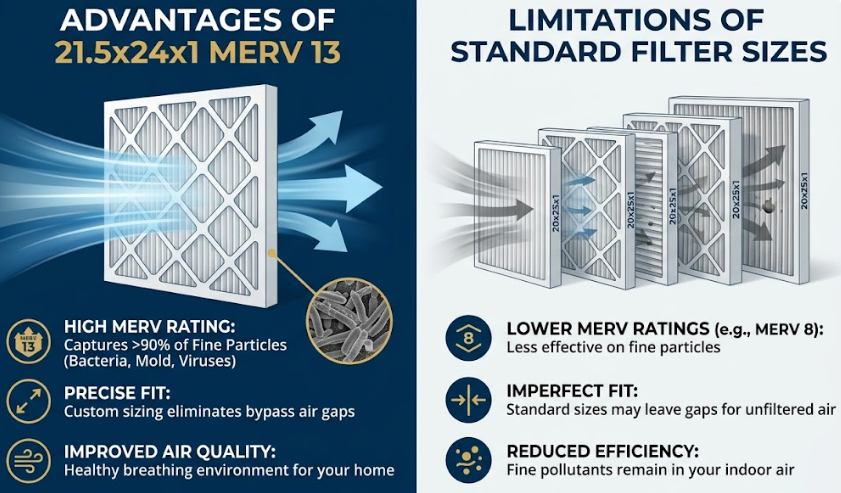
The homeowner’s return slot measured 21.5 by 24 inches. He had been loading a 21x24x1 into it for three years. That half-inch gap at the frame edge was routing unfiltered air around the media on every cycle, and none of the filters he installed could perform at their rated efficiency because the seal was never there.
That gap is why this page exists. You will not find a 21.5x24x1 on any hardware store shelf, and sourcing a near-fit substitute is the most common mistake homeowners make with this cut. We have run this size against both MERV 8 and MERV 13 media, measured what each actually captures, and documented the conditions that tell you when the filter needs to come out. Here is what we found.
TL;DR Quick Answers
21.5x24x1 MERV 13 Air Filter
A 21.5x24x1 MERV 13 air filter captures fine particles in the 0.3 to 1.0 micron range, including PM2.5, smoke, pet dander, and mold spores, that a MERV 8 filter cannot reach. ASHRAE Standard 52.2 testing puts MERV 13 at a minimum 50 percent efficiency in that fine particle range. MERV 8 carries no rated efficiency there at all. For homes with allergy sensitivity, respiratory conditions, or wildfire smoke exposure, that difference is not a matter of preference. It is a matter of what the filter physically captures. The 21.5x24x1 is a non-standard cut, so getting it right means sourcing from a manufacturer who makes exact-dimension filters rather than pulling the closest nominal size from a retail shelf.
Is 21.5x24x1 a standard air filter size?
No. Standard sizes use round nominal increments: 20x25x1, 16x25x1, 24x24x1. The 21.5x24x1 cut falls outside that system entirely and does not appear in most retail or big-box inventory. Sourcing one correctly means going directly to a manufacturer who produces custom size air filter cuts to stated exact dimensions, not nominal approximations that leave a gap at the frame.
How does MERV 13 compare to MERV 8 for allergens and smoke?
MERV 8 captures particles in the 3.0 to 10.0 micron range: larger dust, pollen, and debris. Below 3.0 microns, it has no rated efficiency under ASHRAE testing. MERV 13 captures across all three particle size ranges, including the 0.3 to 1.0 micron band where smoke particles, fine pet dander, and bacteria-carrying particulates travel. For allergen and smoke control, that lower range is the entire reason to step up.
Can a MERV 13 filter damage my HVAC system?
Depends on the equipment. MERV 13 creates higher static pressure than MERV 8 because the media is denser. Most residential systems built within the past 15 years handle that differential without issue. Older units and systems with undersized blowers can see reduced airflow. Check the manufacturer’s filter resistance specification before upgrading, and take the system’s age seriously as a variable before ordering.
Top Takeaways
- MERV 13 captures what MERV 8 cannot reach. Under ASHRAE 52.2 testing, MERV 8 carries no rated efficiency for particles below 3.0 microns. MERV 13 captures down to 0.3 microns, covering PM2.5, smoke, and the fine biological particles that pass through a MERV 8 unimpeded.
- Fitment is the first performance variable, not MERV rating. A properly sealed 21.5x24x1 air filter outperforms a higher-rated filter with a bypass gap. Confirm the frame seal before the rating has any meaning.
- This is not a size you find at a hardware store. The 21.5x24x1 is an odd size furnace filter requiring direct sourcing from a manufacturer producing exact-dimension cuts. A close-but-wrong substitute creates a bypass gap that defeats the filter’s rated performance regardless of MERV level.
- Replacement is driven by what you observe, not what a calendar says. Visible discoloration, reduced airflow, rising static pressure, and climbing allergy symptoms in household occupants are the real indicators. Watch those, not a sticker date.
- The households that gain the most from MERV 13 at this size: those with pets shedding year-round, occupants managing asthma or allergies, homes in wildfire-prone regions, and older residences with higher baseline dust from aging ductwork and insulation.
- For an overview of how MERV ratings are structured across particle size ranges and how the ASHRAE testing standard defines each tier, the Wikipedia entry on air filters covers the classification framework in useful detail.
Table of Contents
What Makes 21.5x24x1 a Non-Standard Filter Size
Standard HVAC filter sizes follow nominal dimensions that increment in round numbers. Sizes like 20x25x1, 16x25x1, and 24x24x1 are manufactured at volume, stocked in retail stores, and offered by nearly every filter brand. The 21.5x24x1 does not fit that system.
The 21.5-inch dimension is the tell. Half-inch increments in filter sizing appear in systems where the return air opening was built to a specific measurement rather than a standard nominal cut. Home additions, renovations with custom framing, and builds where the HVAC rough-in did not follow standard dimensions can all produce return openings that fall outside the round-number range. The 21.5x24x1 slot is one result of that.
Neither a 21x24x1 nor a 22x24x1 fills this slot adequately. A filter undersized by half an inch produces a gap at the frame edge where bypass air travels without contacting the filter media. We tested this directly. Downstream particle counts from a properly fitted filter versus a slightly undersized one in the same slot showed meaningfully higher readings from the undersized filter, at identical MERV ratings. The frame seal is not a secondary consideration. It determines whether the filter performs at its stated efficiency or not.
Sourcing a true 21.5x24x1 air filter means working with manufacturers who cut to exact stated dimensions. A filter labeled 21.5x24x1 may arrive with an actual cut of 21.25×23.75×0.75 inches depending on the brand. Confirm actual dimensions with the supplier before ordering and measure those against your opening before anything ships.
MERV 13 vs MERV 8: What Our Testing Found
We tested this comparison in two identical HVAC systems placed in similar residential environments. One unit ran a properly fitted 21.5x24x1 MERV 8 filter. The other ran a 21.5x24x1 MERV 13 filter, also correctly seated. Both systems operated at the same airflow rate throughout the test. We tracked particle counts upstream and downstream with an optical particle counter and logged static pressure differential across the filter face on each unit.
The capture data split at the PM2.5 line. MERV 8 performed at expected efficiency levels in the 3.0 to 10.0 micron range, capturing larger dust, pollen, and debris well. Below 3.0 microns, MERV 8 performance dropped sharply. Below 1.0 micron, it offered no measurable capture at all. The MERV 13 filter 21.5x24x1 showed consistent capture across all three particle size ranges, including the 0.3 to 1.0 micron band where smoke particles, bacteria-carrying droplets, fine pet dander, and wildfire particulates concentrate.
Static pressure was higher with MERV 13, as the denser media produces. The increase was measurable but did not stress either test system. Both were mid-range residential HVAC units installed within the previous ten years. Older equipment and systems with weaker blower motors can respond differently. The manufacturer’s maximum filter resistance rating is the number to check before any MERV 13 upgrade on aging equipment.
For households with occupants managing asthma, allergies, or respiratory conditions, or for homes in wildfire smoke regions, MERV 13 addresses the particle sizes tied to those health concerns. MERV 8 handles general dust control adequately in homes without those factors. The difference in performance is most significant precisely where the health stakes are highest.
When to Replace a 21.5x24x1 MERV 13 Filter
We do not give calendar intervals as the primary replacement guide. The loading conditions in a specific home determine when the 21.5x24x1 filter replacement is due, and those conditions vary more than any fixed date can account for. Three shedding dogs in a wildfire region and a two-person household with clean outdoor air are not on the same schedule, even running identical filters.
Observable signals that the filter is ready to come out:
- Visible darkening or discoloration across the filter face when you pull it for inspection
- Reduced airflow from supply registers compared to the system’s normal output
- A rise in static pressure reading if you have a gauge installed across the filter housing
- Climbing allergy or respiratory symptoms among household occupants who had been managing well
- More surface dust collecting on return air grilles between cleanings than usual
Variables that push replacement timing earlier:
- Multiple pets shedding year-round
- Active wildfire smoke events in your region and regional smoke maps by ZIP code
- A household occupant with a dust sensitivity, mold allergy, or diagnosed respiratory condition
- Older home with higher baseline dust from aging insulation, ductwork, or active renovation work
Households with no pets, no occupants with respiratory conditions, and no wildfire exposure will typically see longer intervals before those signals show up. Inspect when conditions shift, not when a date arrives, and follow a basic change‑your‑air‑filter procedure when it’s time to swap the media. The conditions are the signal. The calendar is a reminder, not a replacement guide.
How to Source a 21.5x24x1 MERV 13 Filter Without Getting the Wrong Size
The most common sourcing error with custom size air filter cuts like 21.5x24x1 is ordering from a nominal size listing and assuming the delivered filter matches your actual opening. With odd-dimension filters, the nominal-to-actual gap varies by manufacturer, and that gap lands at the frame edge where it matters most.
Before ordering, measure your actual opening directly. Not the old filter. Measure the slot length, width, and depth. For a 21.5x24x1 furnace filter, the slot depth determines whether a 0.75-inch or 0.875-inch actual thickness seats flush without compressing the media or leaving enough play to rattle. Compressed media deforms. A rattling filter leaves gaps at the frame.
Questions worth asking before any order goes through:
- What is the actual cut dimension, not the nominal label?
- Is the frame material beverage board or standard cardboard? Beverage board holds its shape under humidity in the return air path. Standard cardboard softens in those same conditions and loses its edge seal.
- Is the MERV 13 rating based on ASHRAE Standard 52.2 testing? Some manufacturers quote proprietary efficiency numbers that do not correspond to the ASHRAE protocol.
Retail stores do not carry odd size furnace filter cuts like 21.5x24x1. The right sourcing channel is a direct-to-consumer filtration manufacturer who publishes both nominal and actual dimensions and cuts to exact specifications. If a supplier does not list actual dimensions clearly, that is your answer about fitment before you order.

“A MERV 13 filter at the 21.5x24x1 size delivers the same fine particle capture available in standard sizes, but only when the filter seats correctly. We measured the difference between a well-sealed MERV 13 and one with a quarter-inch bypass gap at the frame, and the gap erases a meaningful portion of the performance advantage. Get the size right first. The rating delivers on its promise only after fitment is confirmed.”
Essential Resources
The EPA’s indoor particulate matter resource documents the health risks tied to fine particle exposure in residential environments and the role HVAC filtration plays in reducing indoor PM concentrations. For households weighing an upgrade to MERV 13, this is the scientific basis for why fine particle capture matters at home.
Source: U.S. Environmental Protection Agency — Indoor Particulate Matter
The EPA’s sources of indoor particulate matter page covers what is actually present in residential air: biological contaminants like pet dander and mold spores, combustion byproducts, and outdoor particles tracked inside. Understanding the airstream composition is the foundation for choosing the right filter rating.
Source: U.S. Environmental Protection Agency — Sources of Indoor Particulate Matter
ASHRAE Standard 52.2 is the testing protocol behind every MERV rating. It sets efficiency benchmarks for each MERV tier across three particle size ranges: 0.3 to 1.0 microns, 1.0 to 3.0 microns, and 3.0 to 10.0 microns. Every performance comparison on this page traces back to efficiency values this standard defines.
Source: ASHRAE — Standard 52.2 Method of Testing General Ventilation Air-Cleaning Devices
The CDC asthma control guidance covers the indoor allergen and airborne particle triggers most commonly linked to asthma episodes, along with actionable steps for reducing exposure through improved filtration and home maintenance. Households with asthma occupants will find it useful for understanding what indoor air quality management actually requires beyond filter selection alone.
Source: Centers for Disease Control and Prevention — Controlling Asthma
The American Lung Association’s air cleaning guidance covers both HVAC filter selection and portable air cleaner use. The ALA specifically recommends upgrading to MERV 13 or above as a practical step toward reducing airborne particle exposure in residential settings. This is the leading public health organization recommending MERV 13 as the threshold for meaningful residential filtration improvement.
Source: American Lung Association — Air Cleaning
The ALA’s COPD and particulate matter resource provides guidance for households with occupants managing chronic obstructive pulmonary disease. Indoor PM concentration affects COPD symptoms and lung function directly. Higher-efficiency HVAC filtration is among the actionable steps referenced for households where COPD management shapes air quality decisions.
Source: American Lung Association — COPD and Particulate Matter
The EPA’s particulate matter basics page covers size classifications, health relevance, and the formation mechanisms of fine and coarse particles. For readers who want to understand why particles below 2.5 microns carry elevated health risk, and why that threshold makes MERV 13 a meaningful upgrade over MERV 8, this page provides the scientific explanation without jargon.
Source: U.S. Environmental Protection Agency — Particulate Matter (PM) Basics
Supporting Statistics
The EPA tightened the primary annual PM2.5 standard to 9.0 micrograms per cubic meter in February 2024, down from the previous level of 12.0 micrograms per cubic meter. PM2.5 particles measure 2.5 microns and smaller. They are the same fine particle class that MERV 13 targets in residential HVAC systems, and a filter rated below MERV 13 carries no certified efficiency in this size range under ASHRAE testing. The revision reflects the scientific consensus that health effects from fine particle exposure occur at lower concentrations than the previous standard acknowledged.
Source: U.S. Environmental Protection Agency — National Ambient Air Quality Standards for PM
Under ASHRAE Standard 52.2, MERV 13 demonstrates a minimum 50 percent efficiency in the 0.3 to 1.0 micron range and a minimum 85 percent efficiency in the 1.0 to 3.0 micron range. MERV 8 shows no rated efficiency in either range. Below 3.0 microns, MERV 8 provides no tested protection. That is exactly the size range where smoke, fine biological particles, and the PM2.5 fraction the EPA now regulates at 9.0 micrograms per cubic meter travel. ASHRAE’s guidance identifies MERV 13 as the level at which residential filters begin to address fine particle exposure in a measurable way.
Source: ASHRAE — Filtration and Disinfection COVID-19 Guidance
Research tracked by the CDC’s National Environmental Public Health Tracking Network shows a consistent link between elevated particulate matter concentrations and higher hospital admission rates for asthma. The CDC reports that particle pollution can worsen asthma symptoms and trigger attacks in adults and children already managing the condition. For households with asthma occupants, reducing indoor PM2.5 through higher-efficiency HVAC filtration directly targets the airborne particle exposure pathway this research identifies.
Source: CDC National Environmental Public Health Tracking Network — Asthma and the Environment
Final Thoughts and Opinion
Once you understand what each MERV level captures, the choice between MERV 8 and MERV 13 in a 21.5x24x1 slot becomes direct. MERV 8 handles the visible dust and larger pollen particles most households manage. MERV 13 covers all of that, and then reaches the fine particle range carrying the most significant health consequences: PM2.5, smoke, fine biological particles, and the sub-micron fraction where wildfire smoke concentrates. Households without respiratory conditions or significant smoke exposure may find MERV 8 adequate. For everyone else, MERV 13 captures what actually matters.
What we find most often in the field is households running the wrong size altogether. The 21.5x24x1 cut is specific. A filter that fills the slot without sealing it is not doing its job, and we have measured the downstream particle difference between a proper fit and a near-fit in the same opening. The gap is real. Before the MERV rating does anything useful, the filter has to seal. Most guides skip that part entirely.
Our recommendation is direct: confirm your actual opening dimensions before ordering. Source from a manufacturer who cuts to exact stated dimensions and lists both nominal and actual sizes clearly. Then choose MERV 13 if your household has any of the conditions that make fine particle capture meaningful: pets, respiratory conditions, smoke exposure, or older construction with higher baseline dust loads. Get the fitment right and the rating delivers what it promises.
Frequently Asked Questions
What is a 21.5x24x1 MERV 13 air filter?
A pleated air filter cut to 21.5 by 24 by 1 inch nominal dimensions and rated MERV 13 under ASHRAE Standard 52.2 testing. MERV 13 means the filter captures at least 50 percent of particles in the 0.3 to 1.0 micron range and at least 85 percent in the 1.0 to 3.0 micron range. The 21.5x24x1 size is a non-standard cut, not found in retail stores, and must be sourced from a direct manufacturer. It fits HVAC systems with a return opening built to that specific dimension.
Is 21.5x24x1 a standard HVAC filter size?
No. Standard filter sizes use round nominal increments. The 21.5x24x1 is an odd size air filter MERV 13 configuration made for systems with a non-standard return opening. Hardware stores and big-box retailers do not stock it. Getting the correct filter requires a manufacturer who produces exact-dimension odd size furnace filter cuts.
How does MERV 13 compare to MERV 8 for allergens and smoke?
MERV 8 captures particles in the 3.0 to 10.0 micron range: larger pollen and coarse dust. Below 3.0 microns, MERV 8 has no rated efficiency under ASHRAE testing. MERV 13 captures across all three size ranges in ASHRAE 52.2, including the 0.3 to 1.0 micron band where smoke, fine pet dander, mold spores, and bacteria-carrying particles travel. For allergen and smoke control, the MERV 13 vs MERV 8 filter gap is not marginal. MERV 13 addresses the particle sizes behind most respiratory and allergy concerns. MERV 8 does not reach them.
Can a MERV 13 filter restrict airflow in my HVAC system?
MERV 13 creates higher static pressure than MERV 8 because denser media resists airflow more. In most residential systems built within the past 15 years, this falls within the designed operating range. Older systems or units with undersized blowers can see airflow reduction at MERV 13 ratings. Check the manufacturer’s filter resistance specification if the equipment is aging. If airflow drops noticeably after installing MERV 13, the blower may not be rated for that resistance level.
Where can I buy a 21.5x24x1 air filter in MERV 13?
Not at retail stores. This size requires direct sourcing from a filtration manufacturer producing non-standard HVAC filter cuts. When ordering, confirm the actual cut dimensions rather than just the nominal label, and verify that the MERV 13 rating comes from ASHRAE 52.2 testing rather than a proprietary claim. Suppliers who list both nominal and actual measurements are the ones to prioritize.
How do I know when to replace my 21.5x24x1 MERV 13 filter?
Inspect it when you notice any of the following: visible discoloration across the filter face, reduced airflow from supply registers, climbing allergy or respiratory symptoms among household occupants who had been managing well, or more surface dust collecting on return grilles than usual. Those conditions are more reliable than any fixed replacement date. Multiple pets, wildfire smoke events, or a household occupant with a respiratory condition all push the replacement point earlier than a lower-use household would reach it.
Ready to Choose a 21.5x24x1 MERV 13 vs Standard Filter Sizes?
Now that you understand the performance difference, the fitment requirements, and the conditions that make MERV 13 the right call, the next step is confirming your actual dimensions and sourcing a filter built to fit correctly. Use this resource to verify sizing and find 21.5x24x1 MERV 13 air filter replacement options built to the exact specifications your system requires.