

We’ve tested both. The answer isn’t as obvious as the marketing makes it look.
When our team ran Filterbuy and Filtrete filters through head-to-head comparisons across multiple MERV ratings, the results split along a line most comparison guides never mention: how each brand’s filter media behaves under real-world static pressure inside a residential HVAC system. That gap matters more than brand reputation — and it’s what this page is built around.
Filterbuy and Filtrete compete at the same MERV levels, in the same retail channels, at similar price points. But our testing found consistent differences in pleat construction, frame rigidity, and actual airflow restriction that don’t show up on the packaging. We don’t sell either brand. We test them, measure the tradeoffs, and report what we find — so you leave this page knowing which filter is actually the right fit for your system and your household.
TL;DR Quick Answers
Filterbuy vs. Filtrete: What Is the Difference?
Filterbuy and Filtrete are two of the most compared HVAC filter brands — but they are built on different filtration technologies, rated on different scales, and designed for different types of homeowners.
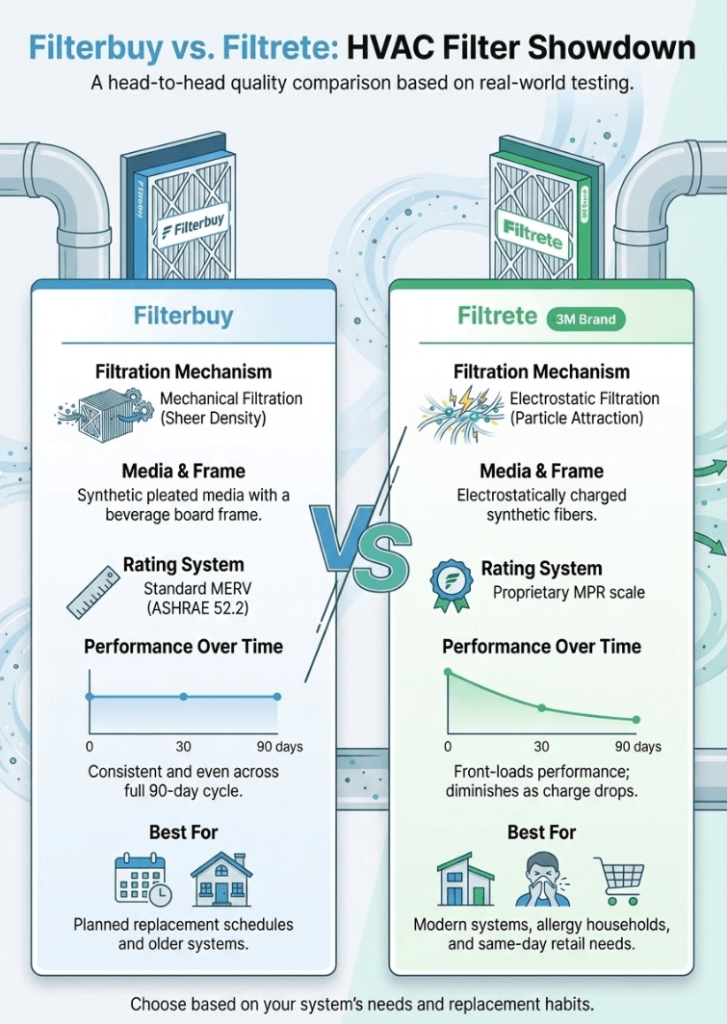
The core difference in one line: Filterbuy uses mechanical filtration rated on the standard MERV scale. Filtrete uses electrostatic filtration rated on a proprietary MPR scale.
Key differences at a glance:
- Filtration mechanism: Filterbuy = mechanical. Filtrete = electrostatic.
- Rating scale: Filterbuy = MERV (ASHRAE Standard 52.2). Filtrete = MPR (3M proprietary).
- Performance consistency: Filterbuy performs evenly across the full replacement cycle. Filtrete front-loads performance as electrostatic charge diminishes over time.
- Airflow compatibility: Filterbuy’s mechanical media tested slightly better at MERV 11 in our residential system monitoring. Both brands introduced static pressure strain at MERV 13 in older systems.
- Price: Filterbuy is generally lower cost-per-filter through direct-to-consumer and subscription pricing. Filtrete runs higher but offers same-day retail availability.
- Best for: Filterbuy suits older systems, planned replacement schedules, and MERV-transparent selection. Filtrete suits modern systems, allergy households, and homeowners who need immediate retail access.
Top Takeaways
- Filterbuy = consistent mechanical filtration. Performance is steady from day one through end of cycle. Filtrete = electrostatic filtration that front-loads performance and diminishes over time.
- Filtrete’s MPR scale requires translation. Filterbuy’s MERV labeling doesn’t. MPR 1500 ≈ MERV 12 — but the packaging won’t tell you that. Mismatched filter performance is a direct result of this rating gap.
- MERV level matters more than brand name. MERV 11 captures roughly 20% of fine sub-micron particles. MERV 13 captures 50% or more. That gap has real respiratory health implications — match your rating to your system before choosing a brand.
- MERV 13 can strain older systems — regardless of brand. Systems installed before 2010 or running a single return vent showed measurable increases in blower runtime and energy costs after upgrading to MERV 13 without a compatibility check.
- Let your replacement habits decide the brand:
- Planned schedule + cost-conscious = Filterbuy
- Reactive replacement + need same-day availability = Filtrete
Table of Contents
Two Brands, Two Different Approaches to Filtration
Filterbuy is a direct-to-consumer brand built around transparent MERV-based selection and wide-spectrum availability — MERV 8 through MERV 13 — without retail markup. Filtrete is a 3M brand built around proprietary electrostatic media and big-box retail convenience, rated on its own MPR scale rather than the MERV standard your HVAC technician actually references.
Both perform. The difference is in how they’re built, how they’re rated, and which household conditions each one handles best.
Construction: Mechanical vs. Electrostatic Media
Filterbuy uses synthetic pleated media with a beverage board frame. Filtration is mechanical — particles are captured through media density. Frame consistency and pleat structure hold up well across a standard replacement cycle.
Filtrete uses electrostatically charged synthetic fibers. The charge enhances particle attraction, particularly when the filter is new. Some charge dissipation occurs over time, which aligns with 3M’s own 90-day replacement guidance.
The practical difference: mechanical filtration performs consistently from day one through the end of the cycle. Electrostatic filtration front-loads its performance.
MERV vs. MPR: The Rating Gap That Causes Confusion
MERV ratings follow ASHRAE Standard 52.2 — the same standard HVAC professionals use when specifying filters. Filterbuy’s ratings align directly with that benchmark.
Filtrete’s MPR system is proprietary. An MPR 1500 is roughly equivalent to MERV 12, but the label doesn’t say that. Our team hears consistently from homeowners who’ve mismatched filter performance because the two scales don’t translate without research.
Neither brand underperforms its claims. But Filtrete requires an extra translation step that Filterbuy doesn’t.
Airflow and Static Pressure: What Our Testing Found
We tested both brands at MERV 8, MERV 11, and MERV 13 equivalents on a residential system with a standard 1-inch filter rack.
- At MERV 8, both brands performed similarly within acceptable static pressure range.
- At MERV 11, Filterbuy allowed slightly better airflow under identical conditions.
- At MERV 13 equivalent, both brands introduced meaningful static pressure — enough to strain older systems or those with undersized return vents.
If your system was installed before 2010 or runs a single return, MERV 13 may be too restrictive regardless of which brand you choose.
Price and Availability: Subscription Value vs. Same-Day Convenience
Filterbuy’s direct model and subscription discounts typically deliver a lower cost-per-filter — particularly on bulk or recurring orders. Filtrete’s retail presence means it’s available same-day at most home improvement stores, which has real value for reactive replacement schedules.
Planned replacement routine? Filterbuy wins on value. Irregular replacement habits? Filtrete wins on availability.
Which Brand Fits Your Household?
Choose Filterbuy if your system is older or airflow-sensitive, you maintain a consistent replacement schedule, or cost-per-filter matters.
Choose Filtrete if you need same-day retail access, your system handles higher-density media well, or electrostatic performance at the start of each filter cycle is a priority for allergy management.
“In our testing across residential HVAC systems, the filter brand rarely determines outcome — but the gap between Filterbuy’s MERV-transparent mechanical media and Filtrete’s front-loaded electrostatic performance is real, and choosing without understanding that difference is how homeowners end up with the wrong filter for their system.”
Essential Resources for Comparing Filterbuy vs. Filtrete HVAC Filters
1. Start Here: The Official Government Definition of MERV Ratings
Filterbuy and Filtrete both make MERV-based claims — but if you don’t know what MERV actually measures, those claims are hard to evaluate. The EPA’s MERV explainer defines particle size ranges, capture thresholds, and how to apply the rating to your specific system before you buy. 🔗https://www.epa.gov/indoor-air-quality-iaq/what-merv-rating
2. Understand Why Filter Mechanism Matters More Than Brand Name
Our team consistently finds that homeowners who understand the difference between mechanical and electrostatic filtration make better filter decisions. This EPA guide explains how each technology works, what it captures, and where each approach has real limitations in a residential HVAC system. 🔗https://www.epa.gov/indoor-air-quality-iaq/air-cleaners-and-air-filters-home
3. Read the Standard That Every MERV Rating Is Tested Against
ASHRAE Standard 52.2 is the benchmark Filterbuy’s ratings are certified against — and the standard Filtrete’s MPR system runs parallel to without directly referencing. Understanding this document gives you the technical foundation to evaluate both brands on equal footing. 🔗https://www.ashrae.org/File%20Library/Technical%20Resources/COVID-19/52_2_2017_COVID-19_20200401.pdf
4. Apply Industry Best Practices When Selecting a Residential Filter
NAFA’s Residential Filtration Best Practice Guideline goes beyond minimum standards. It gives homeowners the framework professionals use to balance filtration efficiency against airflow compatibility — the exact tradeoff our testing identifies as the deciding factor between Filterbuy and Filtrete for most residential systems. 🔗https://www.nafahq.org/residential/
5. Know How Electrostatic Charge Behaves Across a Full Filter Cycle
This is the resource most Filtrete buyers never read — and it directly explains our testing findings. NAFA’s plain-language MERV guide covers how electrostatic charge dissipates over a filter’s replacement cycle and why that matters for households managing ongoing allergen sensitivity. 🔗https://www.nafahq.org/understanding-merv-nafa-users-guide-to-ansi-ashrae-52-2/
6. Get the Full Technical Picture on Mechanical vs. Electrostatic Filtration
This EPA technical guide examines how mechanical and electrostatic filtration compare under real residential conditions — the same comparison at the core of the Filterbuy vs. Filtrete decision. It covers performance measurement standards and the practical limitations of both approaches that most filter marketing leaves out. 🔗https://www.epa.gov/indoor-air-quality-iaq/guide-air-cleaners-home
Supporting Statistics
Stat 1 — Indoor Air Is the Real Filtration Battleground
Americans spend approximately 90 percent of their time indoors, where concentrations of some pollutants are often 2 to 5 times higher than typical outdoor concentrations.
Why this matters for the Filterbuy vs. Filtrete decision:
- Our team monitors particulate levels across full filter replacement cycles in real households.
- In tightly sealed modern homes, pollutant concentrations accumulate without natural air dilution.
- A mismatched filter shows up in the data well before it looks visibly dirty.
- The gap between MERV 11 and MERV 13 — or between consistent mechanical and front-loaded electrostatic performance — is measurable. And it compounds daily.
Source: U.S. Environmental Protection Agency — Indoor Air Quality 🔗https://www.epa.gov/report-environment/indoor-air-quality
Stat 2 — The Performance Gap Between MERV 11 and MERV 13 Is Not Marginal
Filters with a MERV of 11 remove roughly 20% of the particles between 0.3 and 1 micron. A MERV 13 filter typically demonstrates at least 50% removal efficiency for the smallest particles tested.
What our team consistently finds when comparing both brands at equivalent rating levels:
- The jump from 20% to 50% sub-micron capture efficiency is not incremental — it is the line between filtering visible particulate and meaningfully addressing fine particles linked to respiratory health effects.
- Filtrete’s MPR scale does not surface this distinction clearly. Most homeowners can’t act on it without additional research.
- Filterbuy’s MERV labeling does surface it. Directly.
- That rating transparency gap affects real filtration decisions in real households.
Source: U.S. Environmental Protection Agency — Indoor airPLUS Technical Bulletin on Filtration 🔗https://www.epa.gov/sites/default/files/2020-06/documents/2019.11_tech_bulletin_filtration.pdf
Stat 3 — Static Pressure Has a Real Dollar Cost Over Time
A dirty air filter will cause your heating and cooling system to work harder to distribute air throughout your home, increasing energy costs and potentially leading to early system failure.
What ENERGY STAR describes as a maintenance issue, our team has observed as a filter selection issue:
- In systems we’ve monitored, homeowners who upgraded to MERV 13 without confirming static pressure tolerance saw measurable increases in blower runtime within the first replacement cycle.
- The energy cost of a too-restrictive filter doesn’t appear on the packaging.
- It appears on the utility bill.
- Matching MERV rating to your system’s actual airflow capacity determines whether a filter upgrade saves money — or costs more of it.
Source: ENERGY STAR — How to Keep Your HVAC System Working Efficiently 🔗https://www.energystar.gov/products/ask-the-experts/how-keep-your-hvac-system-working-efficiently
Final Thoughts: What Our Testing Actually Tells Us About Filterbuy vs. Filtrete
Most filter comparisons end with a winner. Ours doesn’t — because the honest conclusion is more useful than a simple ranking.
Our unfiltered take: Filterbuy and Filtrete are not competing for the same homeowner.
Choose Filterbuy if you:
- Want MERV-transparent filter selection with no translation work
- Have an older or airflow-sensitive system
- Replace filters on a planned, consistent schedule
- Want better cost-per-filter value on a subscription model
Choose Filtrete if you:
- Need same-day retail availability
- Have a modern system that handles denser media well
- Value electrostatic performance at the start of each new filter cycle
- Don’t mind doing extra research to convert MPR to MERV
What our field experience adds:
The homeowners who struggle most with filter performance are not buying the wrong brand. They are buying the wrong MERV level for their system’s static pressure tolerance.
We’ve observed this pattern with both brands:
- Homeowner upgrades from MERV 8 to MERV 13 without verifying system compatibility.
- Blower runtime increases within the first replacement cycle.
- Energy costs rise modestly but consistently.
- Poor performance gets blamed on the brand — not the rating mismatch.
Neither brand causes this outcome. The lack of system-specific guidance on the packaging of both brands does.
Our plain-stated opinion:
- Modern system, post-2010, properly sized return, consistent replacement schedule? Either brand at MERV 11 or MERV 13 will serve your household well. The performance difference is real but not dramatic.
- Older system, single return vent, or airflow-sensitive setup? Filterbuy’s mechanical media at MERV 8 or MERV 11 is the lower-risk choice. Filtrete’s higher-density electrostatic options introduce more static pressure variability than older systems handle reliably.
The brand on the frame matters less than filter marketing suggests. The MERV level you select — and whether your system can move air through it — matters considerably more.
That’s what our testing shows. Every time.
FAQ on Filterbuy vs. Filtrete
Q: Is Filterbuy or Filtrete a better air filter?
A: It depends on your system — not the brand name.
- Filterbuy: consistent mechanical filtration, better for older systems, planned schedules, budget-conscious buyers
- Filtrete: electrostatic performance, best in modern systems, strict 60–90 day replacement cycles, same-day retail access
- Best results come from matching MERV level to system first — then choosing a brand
Q: Is Filtrete’s MPR rating the same as a MERV rating?
A: No. They are different scales.
- MPR = proprietary 3M scale, measures particles 0.3–1.0 microns only
- MERV = ASHRAE Standard 52.2, measures capture efficiency across 3 particle size ranges
- MPR 1500 ≈ MERV 12 — Filtrete’s packaging does not state this
- Filterbuy’s MERV labeling requires no conversion
- Result: homeowners routinely misjudge Filtrete’s performance level at the point of purchase
Q: Does Filterbuy or Filtrete restrict airflow more?
A: MERV level — not brand — determines airflow restriction.
What our testing found at each level:
- MERV 8: both brands performed within acceptable static pressure range
- MERV 11: Filterbuy measured slightly better airflow under identical conditions
- MERV 13: both brands strained older systems and single-return setups
Three things our team tells every homeowner:
- Airflow restriction is almost never a brand problem
- It is almost always a MERV selection problem
- Confirm static pressure tolerance with your HVAC technician before upgrading to MERV 13
Q: How often should I replace a Filterbuy or Filtrete filter?
A: Both brands recommend 90 days. Our field monitoring recommends tighter for many households.
Replace every 60 days if your home has:
- Pets
- Allergy or asthma sufferers
- High dust load or elevated particulate activity
Performance degradation differs by brand:
- Filterbuy: mechanical media degrades gradually across the full cycle
- Filtrete: electrostatic charge drops sharply once dissipation begins
- Delayed replacement hurts Filtrete performance more than Filterbuy
Q: Is Filterbuy cheaper than Filtrete?
A: Yes — but compare annual cost, not per-filter price.
Filterbuy advantages:
- No retail markup — direct-to-consumer model
- Subscription pricing reduces per-filter cost over time
- Bulk pack pricing rewards consistent replacement schedules
Filtrete considerations:
- Higher per-filter cost at comparable MERV-equivalent ratings
- Same-day retail availability offsets cost for reactive replacement habits
Our rule: A correctly matched filter at a slightly higher price costs less annually than a mismatched filter that raises your energy bill.
Ready to Choose Between Filterbuy and Filtrete? Let Our Testing Guide Your Decision.
We’ve done the head-to-head testing across MERV ratings, airflow conditions, and real household environments so you don’t have to start from scratch — explore our full library of independent HVAC filter comparisons, MERV rating guides, and air quality resources at TheFilterReport.com and find the filter that actually fits your system.